Whether you are a parent of a youth in post-secondary school, applying for a post-secondary school yourself, or already in post-secondary school, the following topic might be a bit alarming, however, it is important to be aware of the employment problems in Canada and the types of situations you will likely be faced with when entering the workforce. Daniel Tencer from HuffPost helps to bring awareness to the rising issue of precarious work through ways in which it is increasingly affecting different groups of Canadian citizens, different industries in the employment sector, and the history of conflict and change regarding precarious work in Canada as a guide for creating change today.
Precarious work. Have you heard of the term? It refers to work that can be unsafe, unprotected, poorly paid and unable to support a household (Tencer, 2019). It is safe to say that nobody would prefer a precarious job. Especially nobody like me who is spending large amounts of money and putting in all hours of the day into my university degree. And unfortunately, the people that make up precarious workers are 30% more likely to have a post-graduate degree. However, this does affect more than the post-graduate population. If you are a woman, your likelihood of landing yourself a precarious job is 60% greater (Tencer, 2019). Even Canada’s working elite find themselves working full-time jobs that lack security and benefits (Tencer, 2019). The effects extend beyond adulthood and also effect old age security (Tencer, 2019). It is safe to conclude that precarious work affects many different sectors of Canada’s society and is setting up Canadian citizens for unstable lives.
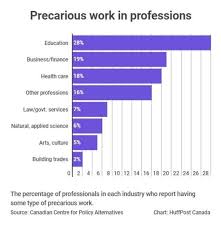
Some might think that they are safe from this work as they plan to go into a government job. Maybe this sounds a lot like your plans? Unfortunately, this will not shield you from the problem. Both health care and education included in the public sector fall into precarious work (Tencer, 2019). The following graph demonstrates the average percentage of Canadian workers in each industry that fall into the category of precarious work. This graph alarms me as I continue to study for my degree in Health Studies, knowing that I have a large chance of finding myself in precarious work.
Why is this a growing problem in Canada you may ask? It is safe to say that Canadian political attitudes are in the way of much-needed change. Historically, precarious work was labelled as factory jobs. If you look today, this is no longer the case (Tencer, 2019). The reason being is that governments began to put forth regulations regarding factory work and unions were formed (Tencer, 2019). If Canada is aware that change is possible, what are they waiting for? Do they want to set up the next generation of workers for failure? Furthermore, I believe pressure from the public – the public being people like us, who are directly affected, can be critical to accelerating the timeline of any changes.
The International Labour Organization (ILO) rose to this issue in 2012 suggesting the important impact that unions and activists have had on encouraging government systems to create regulations to make a change (ILO Publications, 2012). They further highlighted policy responses to precarious jobs which included; social and economic policies, the promotion of collective bargaining, the promotion of existing labour standards, further regulation, capacity building, and trade union campaigns (ILO Publications, 2012). This document put forth for the United Nations, acts as a strong exemplar for Canada to follow more closely. I have attached the link to the ILO’s document as an extensive amount of information is presented regarding precarious work and what needs to be done to see change.
Click to access wcms_179787.pdf
I believe the issue of precarious work is unjust for Canadians given the high standards and impressions that our country holds. If you have any further information regarding precarious work, any further suggestions regarding what can be done, or any comments in general, I would be happy to hear!
Nicole
References
ILO Publications (2012). From Precarious Work to Decent Work. [online] Geneva: International Labour Office, pp.1-8. Available at: https://www.ilo.org/wcmsp5/groups/public/— ed_dialogue/—actrav/documents/meetingdocument/wcms_179787.pdf [Accessed 6 Feb. 2020].
Tencer, D. (2019, February 27). More Than 1 In 5 Canadian Professionals Have Precarious Jobs. Retrieved from https://www.huffingtonpost.ca/entry/precarious-work-professionals- canada_ca_5cd5618de4b07bc7297797c0?guccounter=1&guce_referrer=aHR0cHM6Ly9 0LnVtYmxyLmNvbS8&guce_referrer_sig=AQAAACjcgPce4NPmSA3UMbQ75EWnV SvaaRnJnDnYuNbDX9A6ied4GN09vH-zY53zZhgNxNSbfhtoKpjWsUF6NODMe- ySt8wNzZo8V0os6BMzZ0-5THs09TVRd2B- KemNhxwThozfA2Us9BYrwuWdyCtlnql90Ad_3OYcInWrYWEb3ylU


Hi Nicole,
Great choice of topic, as well as a great response to the article. Many years ago, a post secondary education almost guaranteed you a secure, well paying job, but this is no longer the reality of today. It is scary to think that after spending 4 years at a well reputed university such as Queen’s, and paying tens of thousands, one might not be able to find a job, or even if they do, it may not be secure.
My personal opinion as to the reasons behind the situation we are facing is our choices in today’s society. As I previously mentioned, many years ago you could easily find a job with an undergraduate degree, the reason being, not many were pursuing post-secondary studies at the time. However, today almost everyone chooses to attend post-secondary institutes, hence making the job market much more competitive. In countries like India, as well as many in Europe, it has become customary/necessary to do a masters in order to get a job. I believe this will soon be the case in Canada, as the job market becomes more competitive, and undergraduate degrees start to deminish in value.
A secondary reason behind the precarious work is the new outlook of society towards skills rather than education. Companies like Google, Apple, IBM, and many others no longer require a degree, but want individuals to possess certain skills. I believe this trend will continue to grow in the future, making it much harder to find a job with solely a post-secondary degree, and many more jobs “precarious”.
One thing which is certain is that, “the future belongs to those who believe in the beauty of their dreams”.
Best,
Faiz M
LikeLike