Be yourself; Everyone else is already taken.
— Oscar Wilde.
This is the first post on my new blog. I’m just getting this new blog going, so stay tuned for more. Subscribe below to get notified when I post new updates.
Be yourself; Everyone else is already taken.
— Oscar Wilde.
This is the first post on my new blog. I’m just getting this new blog going, so stay tuned for more. Subscribe below to get notified when I post new updates.
Whether you are a parent of a youth in post-secondary school, applying for a post-secondary school yourself, or already in post-secondary school, the following topic might be a bit alarming, however, it is important to be aware of the employment problems in Canada and the types of situations you will likely be faced with when entering the workforce. Daniel Tencer from HuffPost helps to bring awareness to the rising issue of precarious work through ways in which it is increasingly affecting different groups of Canadian citizens, different industries in the employment sector, and the history of conflict and change regarding precarious work in Canada as a guide for creating change today.
Precarious work. Have you heard of the term? It refers to work that can be unsafe, unprotected, poorly paid and unable to support a household (Tencer, 2019). It is safe to say that nobody would prefer a precarious job. Especially nobody like me who is spending large amounts of money and putting in all hours of the day into my university degree. And unfortunately, the people that make up precarious workers are 30% more likely to have a post-graduate degree. However, this does affect more than the post-graduate population. If you are a woman, your likelihood of landing yourself a precarious job is 60% greater (Tencer, 2019). Even Canada’s working elite find themselves working full-time jobs that lack security and benefits (Tencer, 2019). The effects extend beyond adulthood and also effect old age security (Tencer, 2019). It is safe to conclude that precarious work affects many different sectors of Canada’s society and is setting up Canadian citizens for unstable lives.
Some might think that they are safe from this work as they plan to go into a government job. Maybe this sounds a lot like your plans? Unfortunately, this will not shield you from the problem. Both health care and education included in the public sector fall into precarious work (Tencer, 2019). The following graph demonstrates the average percentage of Canadian workers in each industry that fall into the category of precarious work. This graph alarms me as I continue to study for my degree in Health Studies, knowing that I have a large chance of finding myself in precarious work.
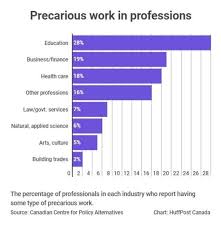
Why is this a growing problem in Canada you may ask? It is safe to say that Canadian political attitudes are in the way of much-needed change. Historically, precarious work was labelled as factory jobs. If you look today, this is no longer the case (Tencer, 2019). The reason being is that governments began to put forth regulations regarding factory work and unions were formed (Tencer, 2019). If Canada is aware that change is possible, what are they waiting for? Do they want to set up the next generation of workers for failure? Furthermore, I believe pressure from the public – the public being people like us, who are directly affected, can be critical to accelerating the timeline of any changes.
The International Labour Organization (ILO) rose to this issue in 2012 suggesting the important impact that unions and activists have had on encouraging government systems to create regulations to make a change (ILO Publications, 2012). They further highlighted policy responses to precarious jobs which included; social and economic policies, the promotion of collective bargaining, the promotion of existing labour standards, further regulation, capacity building, and trade union campaigns (ILO Publications, 2012). This document put forth for the United Nations, acts as a strong exemplar for Canada to follow more closely. I have attached the link to the ILO’s document as an extensive amount of information is presented regarding precarious work and what needs to be done to see change.
Click to access wcms_179787.pdf
I believe the issue of precarious work is unjust for Canadians given the high standards and impressions that our country holds. If you have any further information regarding precarious work, any further suggestions regarding what can be done, or any comments in general, I would be happy to hear!
Nicole
References
ILO Publications (2012). From Precarious Work to Decent Work. [online] Geneva: International Labour Office, pp.1-8. Available at: https://www.ilo.org/wcmsp5/groups/public/— ed_dialogue/—actrav/documents/meetingdocument/wcms_179787.pdf [Accessed 6 Feb. 2020].
Tencer, D. (2019, February 27). More Than 1 In 5 Canadian Professionals Have Precarious Jobs. Retrieved from https://www.huffingtonpost.ca/entry/precarious-work-professionals- canada_ca_5cd5618de4b07bc7297797c0?guccounter=1&guce_referrer=aHR0cHM6Ly9 0LnVtYmxyLmNvbS8&guce_referrer_sig=AQAAACjcgPce4NPmSA3UMbQ75EWnV SvaaRnJnDnYuNbDX9A6ied4GN09vH-zY53zZhgNxNSbfhtoKpjWsUF6NODMe- ySt8wNzZo8V0os6BMzZ0-5THs09TVRd2B- KemNhxwThozfA2Us9BYrwuWdyCtlnql90Ad_3OYcInWrYWEb3ylU

Hello readers!
Welcome to my blog! My name is Nicole Vidovic and I’m a third-year student at Queen’s University in the health studies program. I am also doing a disability and physical activity certificate. A major component of this certificate is that I have a placement at Revved Up. For those of you who haven’t heard, Revved Up is an adapted exercise program run by Queen’s which promotes physical activity for those with mobility and developmental disabilities. I absolutely love my time at Revved Up and it has really made my university experience that much better! On top of school, I love to exercise and travel. A specific type of activity that I spend much of my time doing is kick boxing. As for travelling, book me a flight anywhere and I’ll take it. I spent my last summer in Italy and Croatia which was a beautiful experience!
As a health student I find myself wanting to explore other areas of interest that I have. Being in third year and planning my future and desires for certain jobs/careers, I found it important that I learn about the topic of employment relations. This introductory course caught my attention as it will introduce me to many different topics that is important for any Canadian employee to know. Without this course, I would not be aware of many laws, relations and policies that I am entitled to as a Canadian worker. A specific topic of interest to me is human resources because I believe this is a critical resource that many employees should be highly educated in and aware of to make their work experience better.
Thanks for taking the time to read a little bit about me! Have a great day!
Nicole
This is an example post, originally published as part of Blogging University. Enroll in one of our ten programs, and start your blog right.
You’re going to publish a post today. Don’t worry about how your blog looks. Don’t worry if you haven’t given it a name yet, or you’re feeling overwhelmed. Just click the “New Post” button, and tell us why you’re here.
Why do this?
The post can be short or long, a personal intro to your life or a bloggy mission statement, a manifesto for the future or a simple outline of your the types of things you hope to publish.
To help you get started, here are a few questions:
You’re not locked into any of this; one of the wonderful things about blogs is how they constantly evolve as we learn, grow, and interact with one another — but it’s good to know where and why you started, and articulating your goals may just give you a few other post ideas.
Can’t think how to get started? Just write the first thing that pops into your head. Anne Lamott, author of a book on writing we love, says that you need to give yourself permission to write a “crappy first draft”. Anne makes a great point — just start writing, and worry about editing it later.
When you’re ready to publish, give your post three to five tags that describe your blog’s focus — writing, photography, fiction, parenting, food, cars, movies, sports, whatever. These tags will help others who care about your topics find you in the Reader. Make sure one of the tags is “zerotohero,” so other new bloggers can find you, too.
Have a WordPress.com account? Log in now.

